Double Tulips: The Peony Impostors
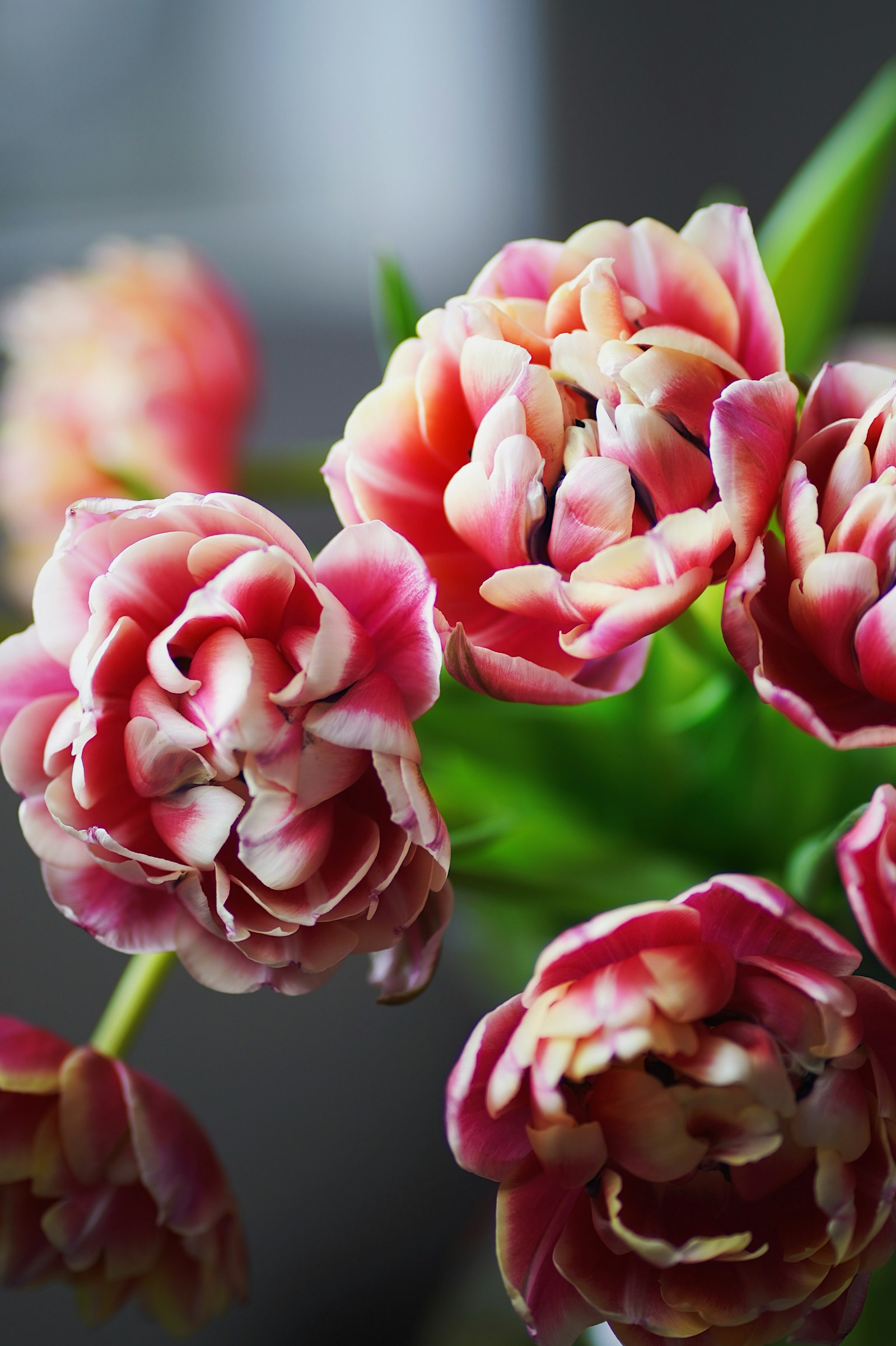
Every year, around mid-April, we get the same message from customers a few times a week: “Are those peonies in your photos? I thought peonies didn’t bloom until May.”
They are almost always looking at a double tulip. And the confusion is entirely fair. Double tulips have dense, full, many-layered petals that fluff out into round globes exactly the shape of a peony. Put a double tulip and a peony side by side in the same photo, at the same exposure, and most people cannot tell which is which without looking at the leaves.
If you love peonies but hate waiting until June to see them, this is your flower.
What “Double” Actually Means
In tulip-speak, “double” refers to the number of petal layers. A standard single tulip has six petals arranged in a single row, forming the familiar cup shape. A double tulip has dozens of petals, stacked in overlapping rings, so the bloom opens into a full, rounded, almost spherical form.
Double tulips come in two loose categories. Double early tulips bloom in the first few weeks of the season, usually on shorter stems, with tight compact blooms. Double late tulips (often called “peony tulips” in the trade) bloom later and tend to be larger, taller, and even more peony-like — the ones most people mistake for actual peonies.
Genetically they are still tulips, but the form is so distinct that they function almost as a different flower in an arrangement. A bunch of single tulips reads as crisp, modern, springy. A bunch of double tulips reads as lush, romantic, wedding-adjacent.
Varieties We Grow
Angelique
The queen of double tulips and probably the most-ordered peony-style tulip in the world. Pale pink petals blushed with deeper pink and cream, forming a tight rosette that opens into a full, blousy bloom over several days. The color gets softer and more watercolor-like as it ages. Angelique is the one that most often gets mistaken for a peony in photos — she is that convincing.
Mount Tacoma
A pure white double tulip with green midstripes on the outer petals that fade as the bloom opens. Large, rounded, almost sculptural form. Mount Tacoma is an heirloom variety, introduced in the 1920s, and still one of the best white tulips on the market for wedding work.
La Belle Epoque
Arguably the most photographed tulip on Instagram. La Belle Epoque opens in an antique palette of cappuccino, dusty rose, champagne, and caramel that shifts across the bloom’s life. No two blooms are identical. The color is so unusual it takes most people a few seconds to even register that they are looking at a tulip.
Black Hero
Deep maroon-black petals with the full double form. Dramatic, moody, perfect for high-contrast arrangements where you want a dark anchor. Pairs beautifully with cream doubles and soft pinks — the combination reads as something between a gothic romance novel and a 17th-century still life.
Foxtrot
Bright cherry pink with white flames running through the outer petals. Double early variety, so it blooms toward the front of the season. The color is brighter and more cheerful than Angelique or La Belle Epoque — the flower equivalent of someone in a good mood on a sunny morning.
Why They’re Perfect for an “Early Peony” Look
Peony season in Minnesota runs late May through June, depending on the year. It is a short, beloved window, and many people spend the preceding weeks quietly longing for it.
Double tulips bridge that gap. A bunch of double tulips in mid-April gives you the visual language of a peony — the full round form, the layered petals, the romantic density — a month before the first real peony opens. For brides planning a May wedding that falls just before peony season, double tulips are often the answer. For anyone hosting a spring dinner party who wants the bouquet to feel lush rather than minimalist, same thing.
Care Notes
Double tulips behave mostly like standard tulips but with a few considerations worth knowing.
Heavier heads, sturdier stems. The blooms are dense and can weigh more than a single tulip, but the stems are usually thick enough to hold them up. You do not need to stake or support them in a vase. Just use a vase wide enough at the mouth to let the heads splay without crowding each other.
Slow to open, long to hold. Doubles are slower to open than single tulips. Expect three or four days from cut to full open. Once fully open, they hold that look for another three to five days. Total vase life of seven to ten days is typical.
Room temperature wins. Unlike many cut flowers, tulips prefer cool water and moderate room temperatures. Avoid direct sunlight, radiators, and warm drafts. A double tulip in a cool room will last noticeably longer than one sitting next to a south-facing window.
Strip the lower leaves. Always. Any leaf sitting in water will rot and shorten the life of the bouquet. Strip everything below the waterline before arranging.
Ordering This Season
Our garden-mix tulip bunches include doubles whenever we have them at peak. Because doubles tend to bloom slightly later than singles, the ratio of doubles in a bunch increases as the season progresses — late April and early May bunches are usually heavier on doubles than mid-March bunches.
If you want a bunch specifically weighted toward doubles — for a wedding, a photo shoot, or just because you love the form — leave a note at checkout. We can usually accommodate it as long as the field is cooperating.
Want the peony look now? Our Grand Bunch (50 stems, $70) gives you enough doubles to make a true peony-style centerpiece. Add a note at checkout requesting doubles if you want them emphasized.
Shop Tulip BunchesAnd Then the Real Peonies Arrive
Of course, the actual peonies are coming. Our first peony buds are usually visible by early May, and first blooms open in late May. If you want both — a double-tulip bunch now, then peonies when they arrive — our peony presale is open.
Between now and peony season, though, there is a whole month of double tulips. Enjoy it.