The Story of Tulips: From the Ottoman Empire to Your Kitchen Table
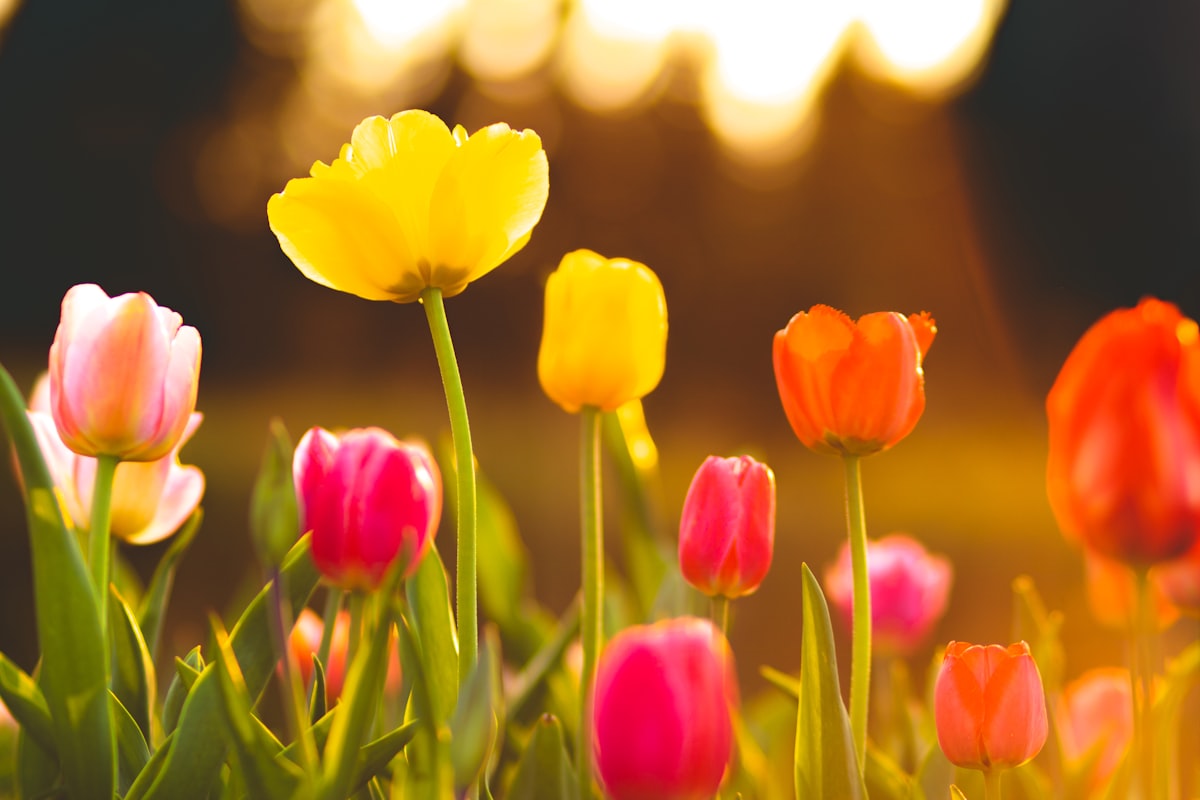
Every spring, tulips appear in gardens, grocery stores, and kitchen tables across the country as if on cue. Their clean lines and saturated colors feel effortlessly modern, the kind of flower that looks equally at home in a minimalist apartment and a rambling farmhouse. But tulips are far from a modern invention. Their story stretches back centuries and spans entire continents, winding through mountain passes, royal courts, financial disasters, and immigrant ships before arriving in the glass vase on your counter. Understanding where tulips come from makes the next bunch you bring home feel a little more extraordinary.
Wild Tulips of Central Asia
If you have ever assumed that tulips are a Dutch flower, you are not alone. It is one of the most common misconceptions in the botanical world. In truth, tulips are native to a broad band of Central Asia stretching from the Tien Shan mountains of Kazakhstan westward through Uzbekistan, Iran, and into the Anatolian highlands of Turkey. Wild tulips still grow in these regions today, though they look nothing like the plump, cultivated varieties we know. They are small, often with narrow petals and muted tones of red, yellow, and orange, perfectly adapted to harsh mountain winters and brief, intense springs.
Botanists have identified more than 75 wild tulip species, and many of them thrive in conditions that would kill most garden flowers: rocky, well-drained slopes at high altitudes with brutally cold winters and scorching summers. This is a crucial detail. The tulip evolved to require a period of prolonged cold in order to bloom. Without those weeks of near-freezing temperatures, the bulb simply will not flower. It is a trait bred into the plant over millennia of mountain life, and it explains why tulips grow beautifully in places like Minnesota but struggle in Miami.
The Ottoman Empire and the Tulip as Symbol
Tulips entered the world stage through the Ottoman Empire. By the early 1500s, Ottoman gardeners had begun cultivating wild tulips extensively, selecting for taller stems, more vivid colors, and elegant pointed petals that the Turks called "lale." The flower became deeply embedded in Ottoman culture. It appeared in ceramic tilework, textiles, poetry, and the illuminated margins of Qurans. Tulips were associated with paradise, divine perfection, and the fleeting nature of earthly beauty.
Sultan Suleiman the Magnificent, who ruled from 1520 to 1566, was a devoted tulip enthusiast. His royal gardens in Istanbul featured thousands of varieties, and the court employed dedicated gardeners whose sole responsibility was breeding new cultivars. But the real peak of Ottoman tulip obsession came later, during the so-called Lale Devri, or Tulip Era, from 1718 to 1730. Under Sultan Ahmed III, tulips became the centerpiece of lavish nocturnal garden parties where thousands of vases lined illuminated walkways and tortoises carrying candles on their shells wandered through the flower beds. The tulip had become more than a plant. It was a statement of imperial power and refined taste.
It was through diplomatic channels between the Ottoman court and European ambassadors that the tulip first traveled west. Ogier Ghiselin de Busbecq, the Habsburg ambassador to Suleiman's court, is often credited with sending the first tulip bulbs to Europe in the 1550s. He described them in letters home with unmistakable wonder, and within a few decades, the flower had taken root in the gardens of Leiden, Antwerp, and Paris.
Tulip Mania: The World's First Speculative Bubble
The Dutch did not invent the tulip, but they did something arguably more remarkable: they turned it into a financial instrument. By the early 1600s, the Dutch Republic was the wealthiest nation in Europe, flush with trade profits from the East Indies. Wealthy merchants competed to display the most exotic and beautiful tulip varieties in their gardens, and prices began to climb. Rare bulbs with streaked, multicolored petals, caused by a virus called tulip breaking, were especially prized. These "broken" tulips produced unpredictable, painterly patterns of white and deep crimson or purple that could not be reliably reproduced, making each bulb essentially unique.
By the mid-1630s, tulip speculation had reached a fever pitch. Bulbs were being traded on paper before they even came out of the ground, in what amounted to an early futures market. A single bulb of the variety Semper Augustus, with its flame-like red and white streaks, reportedly sold for 10,000 guilders in 1637. For context, that was roughly the price of a grand canal house in Amsterdam, or about ten times the annual income of a skilled craftsman. Workers mortgaged their homes and sold their tools to buy bulbs, convinced the prices would keep rising.
They did not. In February 1637, the market collapsed almost overnight. At an auction in Haarlem, buyers simply stopped showing up. Within weeks, tulip bulbs that had traded for thousands of guilders were worth a fraction of their peak price. Historians still debate the severity of the crash. Some argue it was a contained event that affected relatively few speculators, while others see it as a genuine economic crisis that rippled through the Dutch economy for years. Either way, Tulip Mania has entered the history books as the first recorded speculative bubble, a cautionary tale about the gap between perceived value and actual worth that economists still reference when discussing modern market manias from dot-com stocks to cryptocurrency.
Thankfully, our tulips are priced more reasonably than 1637 Amsterdam. Fresh-cut bunches start at $40 for 25 stems, grown right here in Minnesota.
Shop TulipsThe Modern Dutch Tulip Industry
Despite the crash, the Dutch never lost their passion for tulips. In the centuries following Tulip Mania, the Netherlands transformed tulip growing from a speculative hobby into a precision agricultural industry. Today, Holland produces approximately 4.3 billion tulip bulbs every year, accounting for roughly 80 percent of the global supply. The fields of Lisse, Hillegom, and the broader Bollenstreek region bloom in staggering geometric bands of color each April, drawing more than a million tourists annually to Keukenhof, the world's largest flower garden.
Modern Dutch tulip farming is an exercise in scale and efficiency. Bulbs are planted by machine in autumn, harvested by machine in early summer, cleaned, sorted by size, and shipped to distributors across the globe. The Dutch have also pioneered forced bulbing, a technique that uses precisely controlled cold storage to trick bulbs into blooming out of season, which is why you can find tulips at your local florist in December. It is an industry built on centuries of accumulated knowledge, but at its foundation is the same wild mountain flower that evolved on the slopes of Kazakhstan.
Tulips in America
Tulips crossed the Atlantic with Dutch settlers in the 1600s, finding a new home in the gardens of New Amsterdam, which the English would later rename New York. But tulips truly took hold in the American Midwest, where the climate closely mirrors the continental conditions of their Central Asian homeland: long, cold winters followed by a relatively quick transition into warm spring weather. Dutch immigrant communities in Michigan, Iowa, and Minnesota brought bulbs with them as a living connection to the old country, and many of those communities still celebrate with annual tulip festivals.
Holland, Michigan, hosts one of the largest tulip festivals in the country each May, with more than five million tulips planted along its streets. Pella, Iowa, and Orange City, Iowa, hold similar celebrations rooted in their Dutch heritage. But tulips are not just a nostalgic tradition. The American cut flower market has grown steadily, and domestic tulip farming, while still small compared to the Dutch juggernaut, is gaining ground as consumers increasingly seek locally grown, seasonal alternatives to imported flowers that spend days in refrigerated cargo holds.
Why Minnesota Is Ideal for Tulips
Of all the places in the United States where tulips thrive, Minnesota deserves special mention. Remember the wild tulips of Central Asia that evolved to require prolonged cold? Minnesota delivers that in abundance. Our winters routinely push below zero for weeks at a time, providing exactly the kind of extended dormancy period that tulip bulbs need to develop strong root systems and store the energy required for a vigorous spring bloom. Without that cold treatment, known as vernalization, the chemical processes inside the bulb that trigger flowering simply do not complete.
But cold alone is not enough. Minnesota also offers rich, well-drained prairie soil that closely resembles the loamy mountain slopes where tulips originated. The soil here is deep and fertile, the product of thousands of years of tallgrass prairie ecosystems building organic matter. And critically, Minnesota provides the dramatic spring temperature swing that tulips love. When temperatures climb from the 30s into the 50s and 60s over the course of a few weeks in April and May, the warming soil sends a signal to the dormant bulbs that it is time to push upward. The result is a bloom season that is concentrated and spectacular, with stems that are thick, strong, and deeply colored.
From Our Farm to Your Table
When you trace the full arc of tulip history, from the windswept mountains of Kazakhstan to the Ottoman sultan's moonlit gardens, through the speculative frenzy of 17th-century Amsterdam and across the Atlantic to the American Midwest, you start to see each tulip differently. That bunch in your vase is not just a pretty flower. It is a living artifact of human desire, cultural exchange, and centuries of careful cultivation.
At Tulip & Peony Co., we grow our tulips the way they were meant to be grown: in real soil, outdoors, subject to the same rhythms of cold and warmth that have shaped this flower for millennia. Our bulbs spend the winter buried beneath Minnesota snow, developing the strong root systems and stored energy that produce the thick stems and vivid color our customers recognize. We do not use synthetic pesticides or chemical growth regulators. We do not fly our flowers in from Holland or South America. What you get is a tulip that was in the ground yesterday and in your hands today, carrying with it a story that began thousands of miles and hundreds of years away.
There is something deeply satisfying about placing a bunch of locally grown tulips on your kitchen table and knowing the full weight of where they come from. They are not just a decoration. They are a direct line connecting you to mountain wildflowers, imperial gardens, financial manias, immigrant traditions, and the particular magic of a Minnesota spring. That is a lot of history for a $40 bunch of flowers.
Experience the tradition yourself. Our tulip bunches are grown on our Minnesota farm, chemical-free and cut fresh for every order.
Shop Tulips Our Story